
Don Binney: Two Aspects of Tokatoka
“Markedly early in Don Binney’s painting career, birds were proving a curse as well as a blessing. By the mid-1960s, he would find himself typecast as the ‘Bird Man’, a purveyor of national symbolism - a moniker which placed him conveniently within the rubric of two prevalent strands in New Zealand culture, nationalism and regionalism… Regardless of whether his bird paintings were caught in a critical up – or downdraft – and their fortunes have fluctuated over the past half century – they remain his defining achievement. Yet the birds were always part of a wider awareness of environmental concerns.”
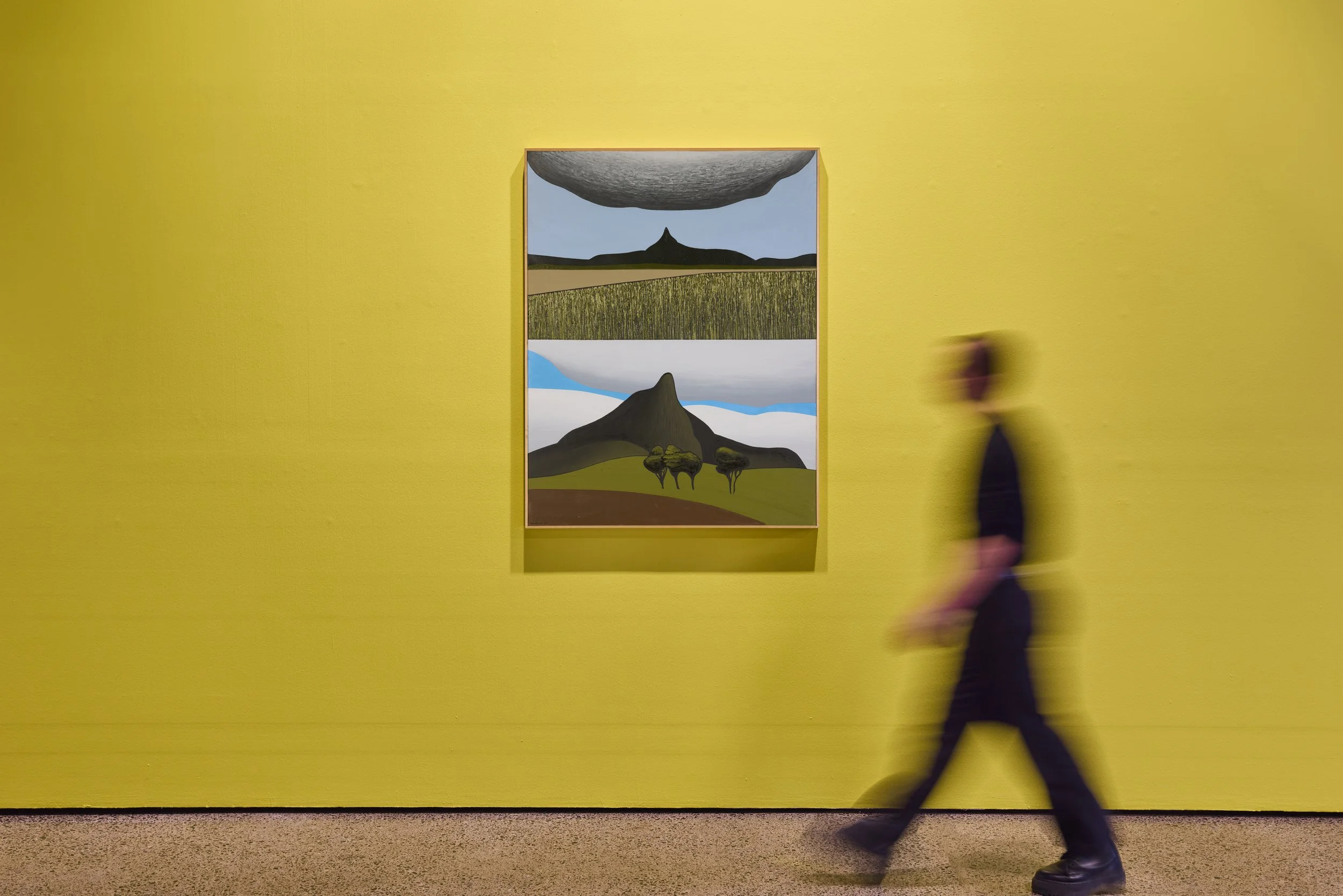
Lot 54. Don Binney, Two Aspects of Tokatoka, 1980, oil on board, 1200 x 920mm.
Price Realised incl. BP: $400,000
24.11.25
Works of Art | Live Auction
As Sheridan Keith succinctly pointed out in her conversation with Binney, published in Art New Zealand 28,
“From almost the first exhibited works the elements of a Binney painting are all there... sky, land, horizon, bird... along with the implications of human occupancy.”
Not every Binney composition, however, contain all these elements. Bird-less landscapes, or more specifically, Binney’s idiosyncratic interpretations of specific landforms, consistently punctuated his wider practice throughout his long career. The earliest examples can be found in his McCahon-esque responses to Te Henga on Auckland’s west coast in the early 1960s. These were followed by dramatic pared back images of Mount Hikorangi, with its “clear, scooped-linear profile”[iii] among other minimal bird-less landscape works in his Northland Journey series of 1964.
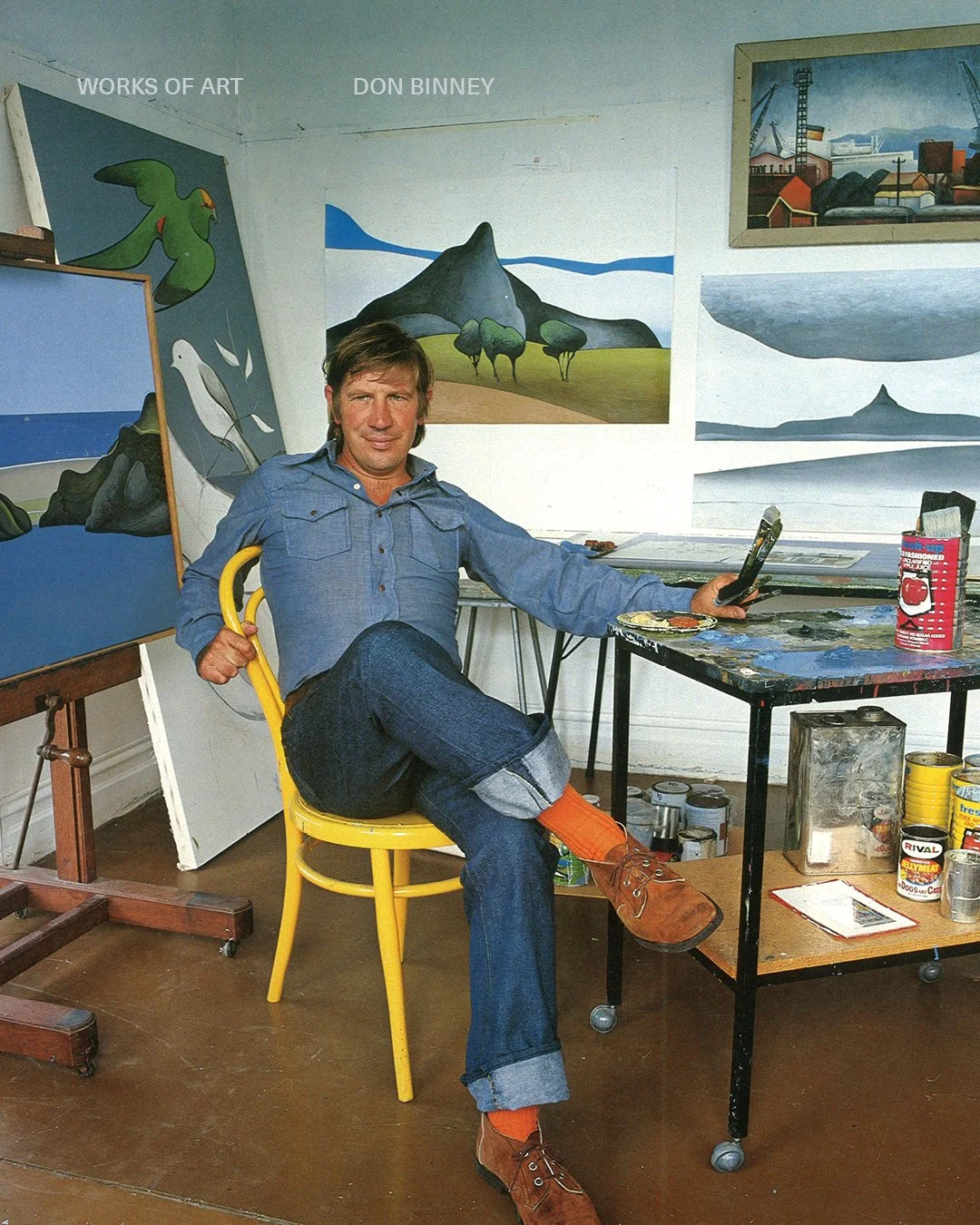
Don Binney in his Studio alongside a similar example of Tokatoka, Photographed by Marti Friedlander, 1980
Fifteen years later, another significant Northland land feature, Tokatoka Peak, overlooking the Wairoa River, in the northern reach of the Kaipara Harbour, captured Binney’s attention. “In notes accompanying the 1980 exhibition ‘Points North’, which featured numerous Tokatoka works, Binney stated his attraction to the ‘curious vertical plug’ – a geological feature which was, he discovered, an extension, northward of the Anawhata -Te Henga area rock faces, islands and headlands“ [iv] that had been the most recurrent geographic local for his practice for decades. “For all its singularity, he considered Tokatoka very much part of a network, an arrangement, a broader pattern in geological as well as human and autobiographical terms. After the complex rhythms of Te Henga, here was a singular form, almost dolmen-like, a steadying presence presiding over rolling hills and farmland. [v]
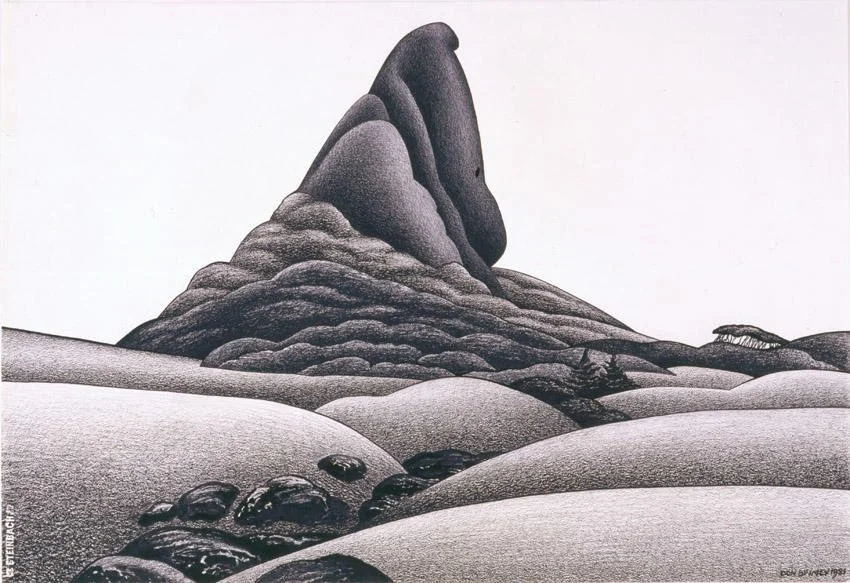
Don Binney- Maungaraho, Spring ’81, From the Collection of the Dunedin Public Art Gallery.
The painting in oil and acrylic of Two Aspects of Tokatoka, 1980, featured in Webb’s recent Works of Art catalogue, is the second version of this subject. The first, with the same name, is reproduced on page 255 in Gregory O’Brien’s seminal tome, Don Binney Flight Path, 2023. In my opinion, the double composition in this later work feels far more resolved. The closer viewed image of Tokatoka Peak in the top half of the 1979 version appears to sit incongruously on the curving cloud that hovers above the more distant rendition of the peak below it, suggesting ambiguous and fantastical spatial relationships. In the late version, however, Binney reverses the placement of the close and distant views of the peak. With the closer view in the lower half of the composition, the separation between the ‘two aspects’ is more plainly defined. The rain-laden cloud that so confused the earlier composition now sits clearly at the top of the panel, successfully capping the conjoined image and providing tonal counterbalance to the dark greens of the larger image of Tokatoka in the lower half.
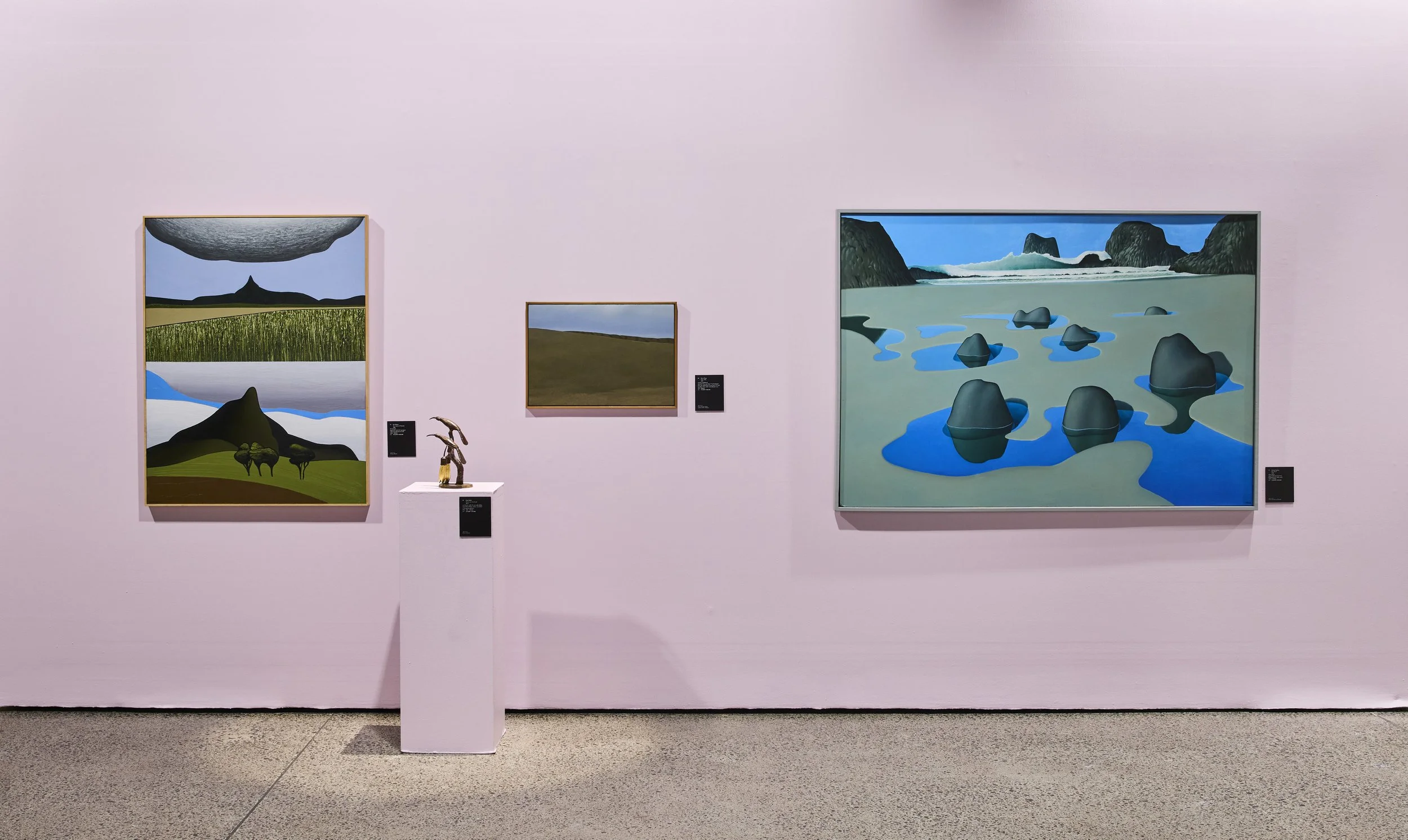
From left to right: Lot 54, Lot 10, Lot 60, Lot 57.
This revised composition invites the viewer to read this sequential diptych of images from top to bottom, effectively evoking the memory of approaching Tokatoka Peak by car or by tightening the focus while viewing it through field binoculars.
A likely interpretation of Binney’s title of this work is that the "two aspects" have dual meanings. Not just the different visual viewpoints, but also the different historical and cultural views. On the one hand the Te Ao Māori pre-European view and the modern-day view. [vi]
The Ngapuhi and Ngati Whatua creation story is that 5 brothers journeyed from Hawaiki to New Zealand. The brothers included Tokatoka, Maungaraho and Manaia. Manaia ran ahead while Tokatoka and Maungaraho stopped to collect toheroa on the Westcoast beach. As sun rose, Atua turned the brothers to stone: Manaia at Whangarei Heads; Tokatoka and Maugaraho on the banks of the Northern Wairoa River.
One commentator has suggested that if the top "aspect" is the pre-European Māori view wherein the dominant thick dark cloud is a depiction of Atua. Binney was, of course, a devout Christian and would certainly have been aware of the biblical narratives of the Old Testament in which God appears as a think dark cloud.
Supporting this interpretation is the observation that the river in the top aspect is a much lighter colour while in the bottom aspect it is a dark brown. According to scientific and historical accounts the Northern Wairoa River was not always muddy brown. This has occurred because of deforestation of the land and intensive farming resulting in soil run off into the catchment. The pre-European river was not muddy .
The bottom European aspect shows an absence of raupo on the banks of the river while the Māori view is thick with shoreline vegetation. Again, the European aspect shows a cleared land with two sparse trees amongst pasture which is absent in the more untouched Māori aspect.
In this way, perhaps Binney was telling a narrative that the European destruction of the landscape so well reflected in the Northern Wairoa river was contrary to Atua or god's intention. Tokatoka (and his brothers) bearing silent witness to this distruction and pointing us back to a Te Ao Māori beginning. [vii]
[i] Gregory O’Brien: Don Binney: Flight Path, Auckland University Press, 2023, (pages 16,17)
[ii] Sheridan Keith: A Conversation with Don Binney, Art New Zealand 28, 1983 (page 18)
[iii] Gregory O’Brien, ibid (page 88)
[iv] Gregory O’Brien, ibid (page 253)
[v] Gregory O’Brien, ibid (page 253)
[vi] Personal interpretations on Binney’s inspiration for Two aspects of Tokatoka, quoted from correspondence Webb’s received from a client when we publicised the sale of this work
[vii] Personal interpretations on Binney’s inspiration for Two aspects of Tokatoka, quoted from correspondence Webb’s received from a client when we publicised the sale of this work.
Printed Catalogue
Works of Art
Auction Details
Live Auction, Auckland
Monday 24 November, 6.30pm
Auckland
Viewing: 19—23 Nov
Live Auction: Mon 24 Nov, 6.30pm
33a Normanby Rd, Mt Eden