
Colin McCahon—Essay by Peter Simpson
Floodgate I (1964–65) is one of a pair of works with that title (Floodgate 2 is dated 1965), painted when Colin McCahon was in his mid-40s and had recently left his curatorial job at Auckland Art Gallery to teach at Elam School of Art.
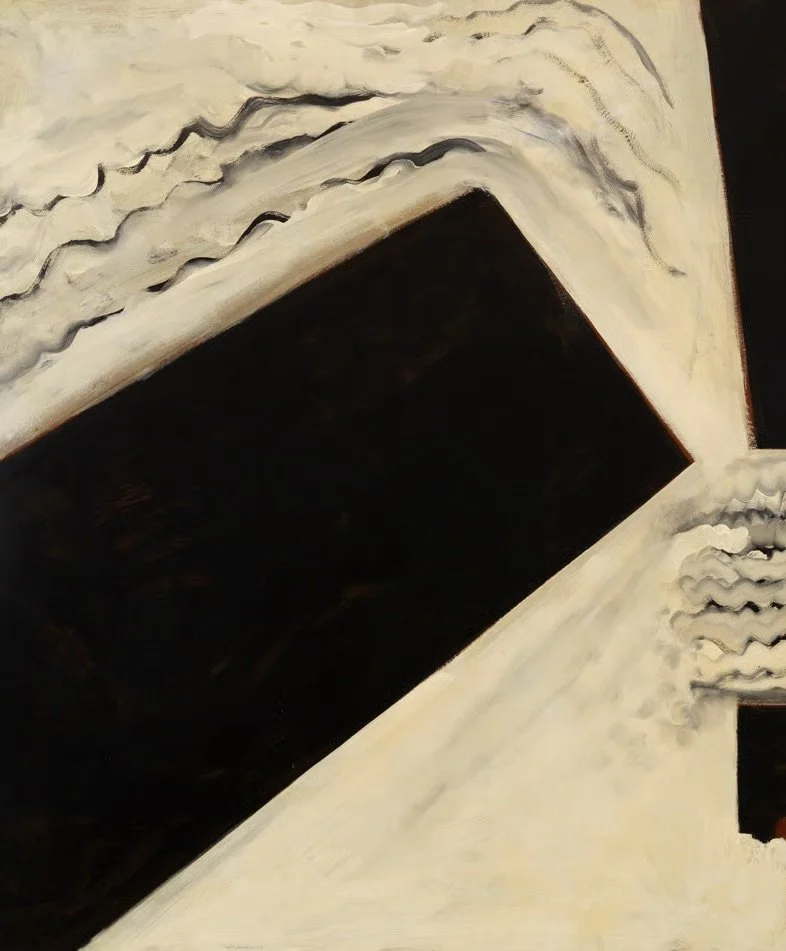
Lot 18. Colin McCahon, Floodgate I, 1964-65, oil on composition board, 909 x 763mm.
EST. $240,000—$280,000
Floodgate I (1964–65) is one of a pair of works with that title (Floodgate 2 is dated 1965), painted when Colin McCahon was in his mid-40s and had recently left his curatorial job at Auckland Art Gallery to teach at Elam School of Art. It was a transitional moment in his career that saw him moving away from the hard-edged, geometrical abstraction of the extensive Gate series (1961–62) towards landscape-related motifs, as in the large Waterfall series of 1964–66 and others.
In a sense, the Floodgate works register this transition, as they allude to the Gate series, both in their titles and in their geometrical imagery, and to the Waterfall series in their depiction of moving bodies of water. The Gate-period preoccupation with issues of ‘barriers’ and ‘ways through’ (gates being both of these things simultaneously) is here applied to the real-world context of rivers and flood control.
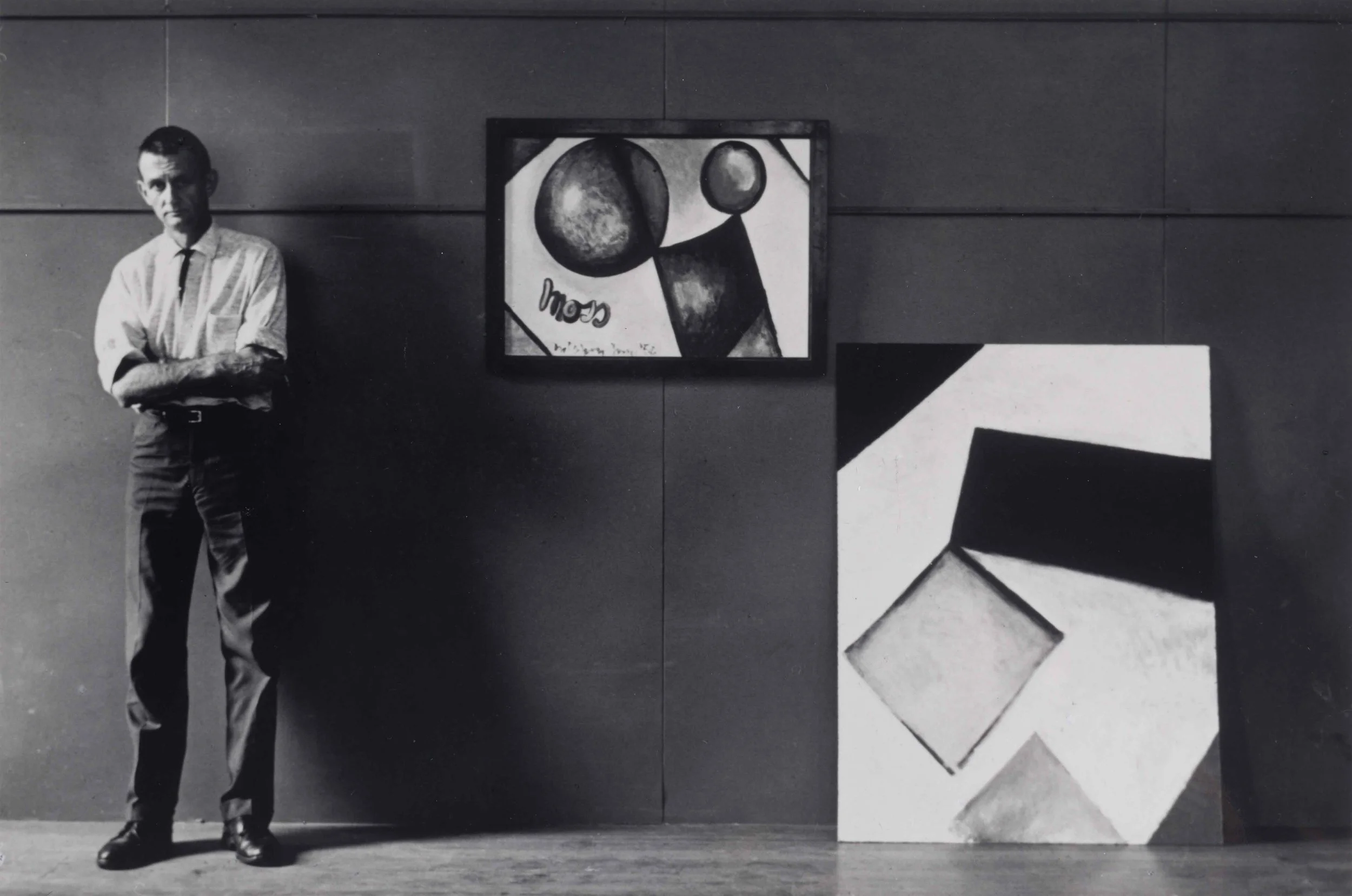
Colin McCahon photographed in the Auckland City Art Gallery with Moss (1956) and Gate (1960), 1961.
Photograph by Bernie Hill. E H McCormick Research Library.
“Floodgates are mechanisms engineered for the control of water, especially in flood conditions. It is possible that the idea of extending gate imagery in this direction came to McCahon through designing a cover for Ruth France’s novel Ice Cold River (1961) – a design that utilises both gate and waterfall imagery.”
—Peter Simpson
Associate Professor
at the University of Auckland
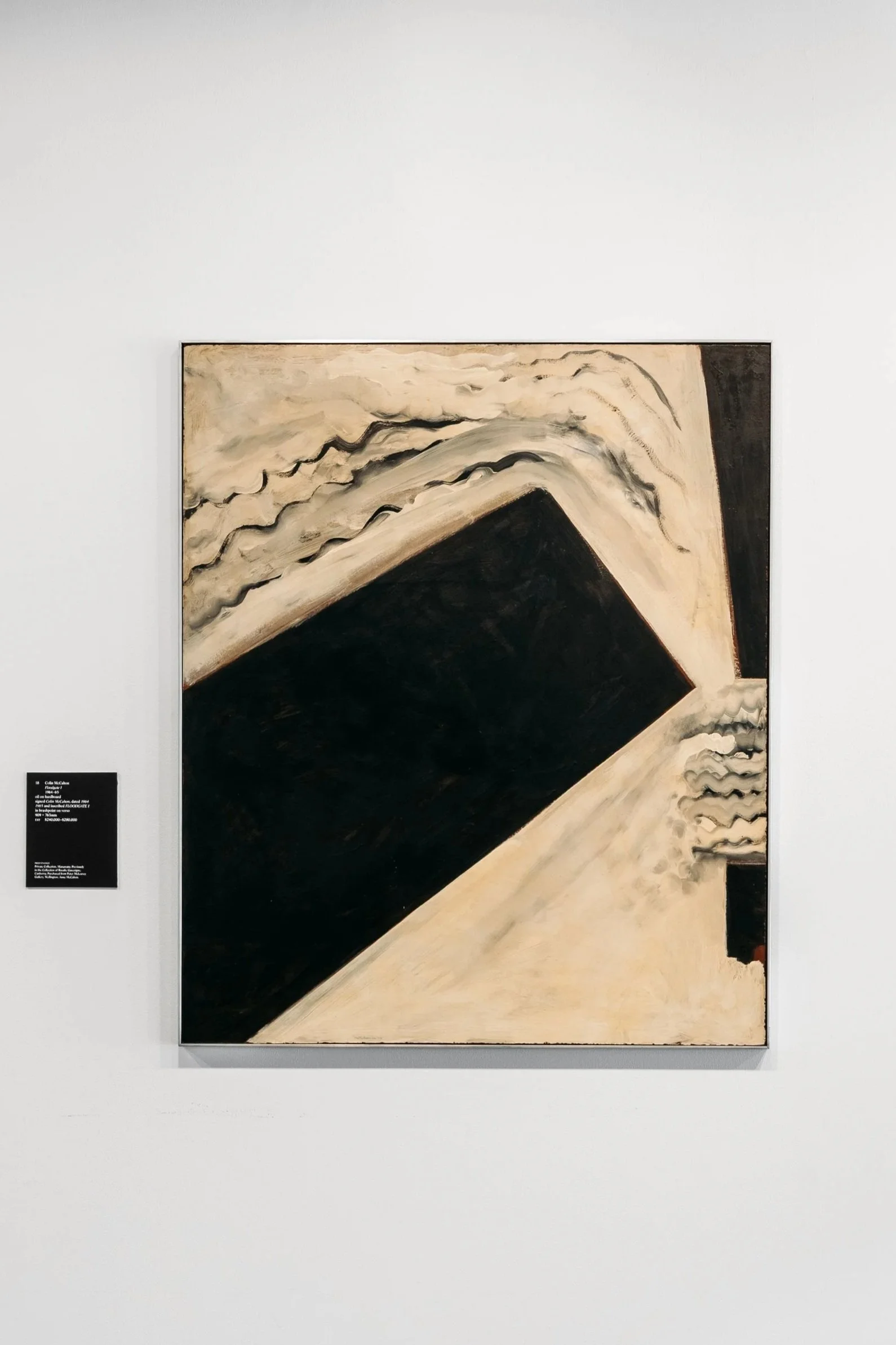
Installation view—Colin McCahon, Floodgate I, 1964-65.
The squarish Floodgate I is dominated by a large black rectangular form thrusting diagonally upwards from bottom left towards upper right, the shape being emphatically cropped by the frame.
A second black form, narrow and tapering, extends from the top down the right edge of the painting. The small gap between them, through which (in a landscape reading) creamy-white water is turbulently gushing, is the focal point of the painting.
Agitated water also enters the picture horizontally and lower down from the right. Turbulence is suggested by dark wavy lines running through the billowing foam, debouching into a calmer, less agitated region in the bottom-right segment of the work.
The Floodgate paintings originally belonged to McCahon’s wife, Anne, but in 1972 they were among three previously unexhibited works sent by the artist to his Wellington dealer, Peter McLeavey, for sale on her behalf. Floodgate I stayed in his stockroom, until it was acquired by the New Zealand-born Australian sculptor Rosalie Gascoigne (1917–99), who retained it for the rest of her life – a part of the backstory of the painting that adds considerably to its interest.
Rosalie Gascoigne, an almost exact contemporary, had a deep admiration for McCahon’s work. She once told an interviewer: “I would cross the seas to go anywhere with Colin McCahon … I really think he’s the greatest Antipodean.”
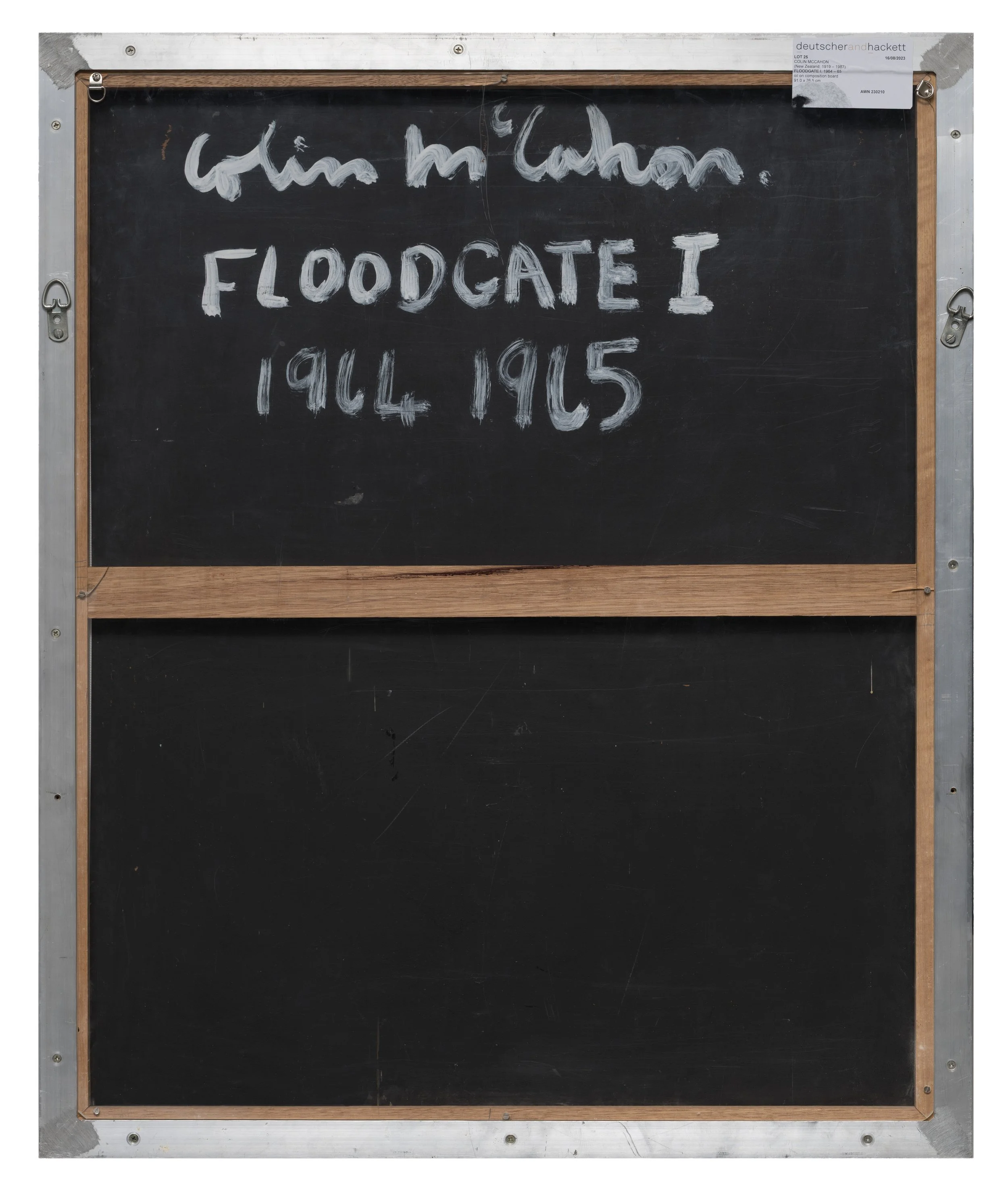
Verso of the Floodgate I, 1964-65, oil on composition board, 909 x 763mm.
Coincidentally, Gascoigne’s first New Zealand exhibition, Sculpture 1975–82 (1983–84), was at Wellington’s National Gallery at the same time as a comprehensive exhibition of the Gallery’s McCahons: The Mystical Landscape. While visiting Wellington for the event, she purchased Floodgate I, saying, “It is a good strong McCahon and I am thrilled to have it.”
She spoke to McCahon by phone before returning to Canberra, particularly praising the Northland panels, as seen in Wellington; McCahon apparently responded with typical modesty: “Not really a very good painting.” Later she wrote of McCahon’s Wellington exhibition: “The power of its honesty was almost overwhelming. Here is an artist who draws his art from within himself. He speaks of who he is, where he lives and what life has made and is making of him.”
These qualities are strongly evident in the dynamic and forceful Floodgate I.
30.03.26
Works of Art | Live Auction
Featuring Works From Sir Miles Warren’s Personal Collection
Printed Catalogue
Queenstown
Viewing | 4—7 March
Launch | Wed 4 March, 6.30pm
(By invitation only)
Amisfield, 10 Lake Hayes Rd
Works of Art
Auction Details
Live Auction, Auckland
Monday 30 March, 6.30pm
Location
33a Normanby Rd, Mount Eden, Auckland
Auckland
Viewing | 25—29 March
Launch | Wed 25 March, 6pm
33a Normanby Rd, Mount Eden
Wellington
Viewing | 12—14 March
Launch | Wed 11 March, 5.30pm
23 Marion Street, Te Aro
Christchurch
Viewing | 18—21 March
Launch | Sat 21 March, 11am
Ōhinetahi, 31 Governors Bay Teddington Rd
View all articles & videos here