
Liz Maw: Painting On Her Own Terms
Two major works by painter Liz Maw went under the hammer through Zoomorphic Lounge (July 2026), and to coincide, Maw invited Megan Shaw, Manager, Art at Webb's to her Mount Eden home and studio. She spoke about sitters, resisting fixed meaning, and painting exactly as she pleases.
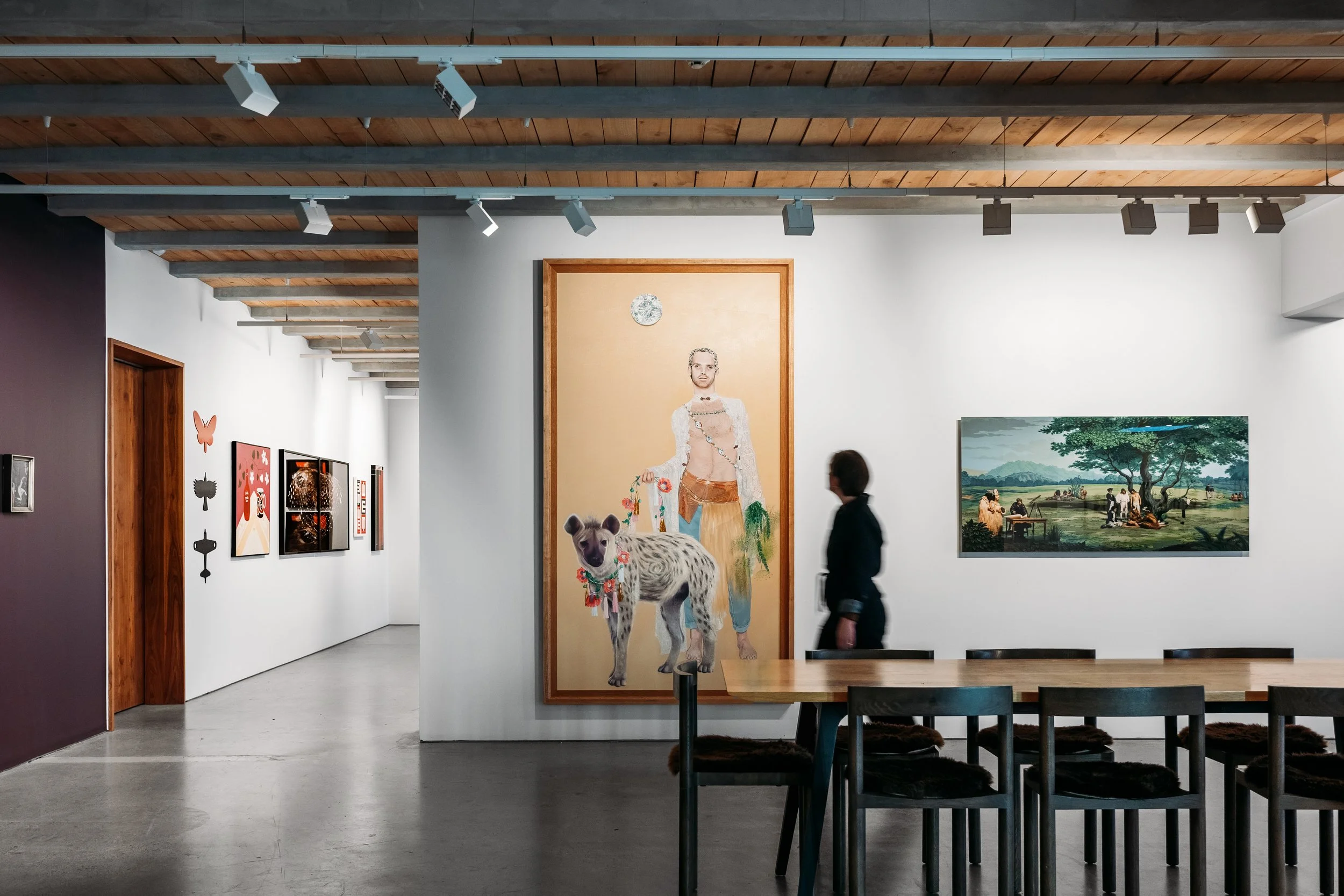
Installation in Wellington
Megan Shaw, Manager, Art
I met Liz Maw at her home and studio in Mount Eden on a drizzly winter afternoon, beginning outside in the garden. She pointed out plants: what was being tended to, cut back, and which flowers were going over for the season. She gave me four cuttings wrapped in damp kitchen towel and tinfoil, the gesture of someone who has grown much of what surrounds her this way: taken, rooted and regifted. A statue of David stood on the grass, his pubic hair pointedly added back on. She invited me to return in summer for more cuttings and a drink, when the garden looks like a 1990s Pierre et Gilles print, "gay as."
Inside the studio, we sat with a painting she has been working on for six months, still being negotiated, before returning to the porch overlooking the garden to record the interview.
Maw, in a black fur coat, smoking, both of us sharing a drink, spoke with the same directness that marks her work: grounded in the physical reality of painting, her vast references, and the enduring presence of the artist's hand.
Megan Shaw: How do you choose or "cast" someone in your paintings? It feels almost cinematic, where a figure carries something beyond themselves, and doesn't resolve into one fixed meaning.
Liz Maw: I use people in my environment, from the art world, my community. Even though they're not really portraits... there are a couple here and there like Mary (2013), but mostly they're models. But the person is still there. People identify with it. These are people from my world. My work is New Zealand work.
It's like a bolt out of the blue. Sometimes I have an idea and a person together... they trigger some kind of ancient archetype for me.
I've always thought that if I didn't paint, I would make movies. I just know how to do it. But for filmmaking you need an army of people to believe in you. I've never really had that. If you're controlling and making something yourself, you've only got yourself to blame if you mess it up.
People are multifaceted. They've got good things and bad things about them. A character could be a very bad character, or not. That's what I'm interested in.
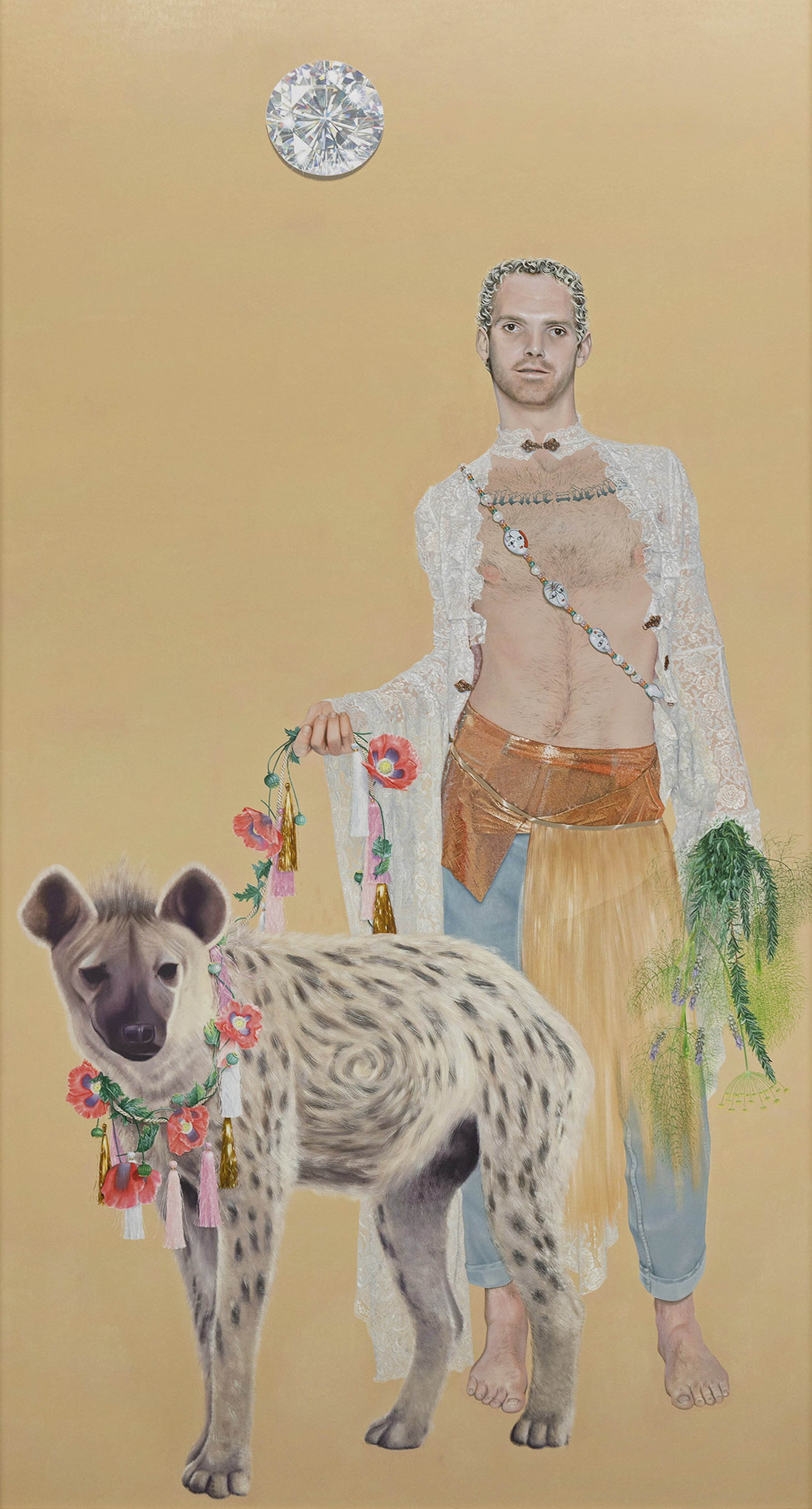
Lot 28. Liz Maw, Palammino, 2020, oil on board, 2340 x 1250mm.
EST. $75,000—$90,000
MS: We're fortunate to be handling two major works of yours in this sale. The first is Palammino (2020), which casts the Walters Prize nominee and artist Owen Connors. You've mentioned being inspired by images that carry a very direct, almost confrontational sense of power. Can you talk about how that shifts in this painting?
LM: I was inspired by those photographs by Pieter Hugo, his Hyena and Other Men series. I wanted "soft power" instead of power-power. That's obvious in those images. You've got these Nigerian "hyena-men" with aggressive animals on chains. I mean, that's just one thing, isn't it? It reads immediately as power. They're in this space between dominance and submission.
I wanted to do something that wasn't obviously malevolent. Not that kind of direct thing. It's got such a sweet face. I wanted to make my hyena very soft, very sweet... but still a little tough. So, it could be read as gentle or it could go another way. That's the tension. But it's not really about the animal literally, it's about that feeling.
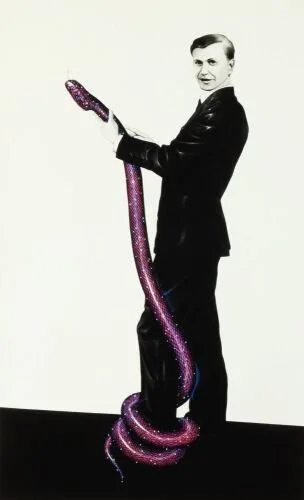
Lot 29. Liz Maw, Young David Attenborough, 2007, giclée print on paper, 615 × 418mm.
EST. $2,000—$3,000
Price Realised (Incl. BP): $2,390
MS: You've described your works as not quite portraits in the traditional sense. Can you talk about how you construct a figure, particularly when different people or references are brought together within a single work?
LM: Yes, it's not really about portraiture. In The Young David Attenborough (2007) the body was a different person. It's enough to know the person, they're part of my world, but they're also standing in for something else. People want to read things literally, but I'm not interested in that.
MS: There are symbolic elements throughout your work like flowers, but you also seem hesitant to fix their meaning. Is there a language there, or is it deliberately left open?
LM: Sometimes. A lot of the plants and flowers in the work are aromatic. I like that element. I'm not going to tell you why. You have to figure it out for yourself. That's the point.
MS: Your works are eye catching in print or on screen, but they feel so rich in person. The surface of Mary (2013) is remarkable. How important is that physical encounter?
LM: It's everything. A work like Mary looks so much better in the flesh. It's the surface of the background, working with interference paints. I did it all with a small brush because I wanted it to feel like a smoke-filled room coming from her one cigarette. There's a carelessness in how the ash falls.
I don't want to compare myself to Rembrandt, but when I saw his paintings in Europe for the first time, it was completely different to reproductions. Seeing them makes a huge difference. It's the same thing here. People should come and look.
MS: This painting of Mary Vavasour, the significant art consultant and gallerist, is she a portrait?
LM: It's a fantasy portrait. She would never be seen dead in that, that was a full-on diamanté bustier, which I've still got. She wore it, but it's symbolic.
The costume is a signifier for inhabiting a world of opulence and class, and a laissez-faire way of manoeuvring through it. The bustier and the cigarette are creating a certain kind of perception. The long ash is important too, that's also a symbol of authority and indulgence.
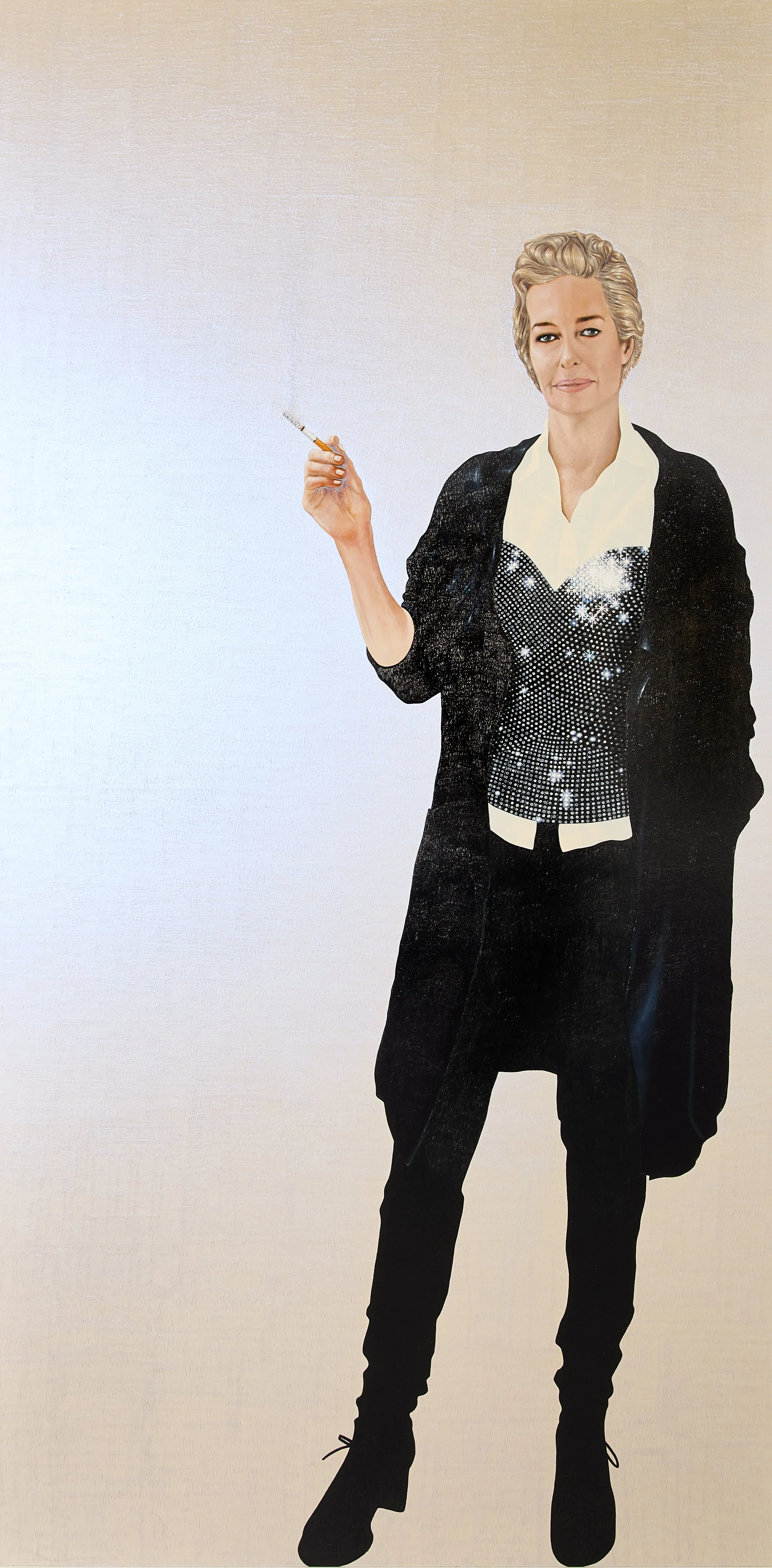
Lot 32. Liz Maw, Mary, 2013, oil on board, 2120 x 1090mm.
EST. $55,000—$70,000
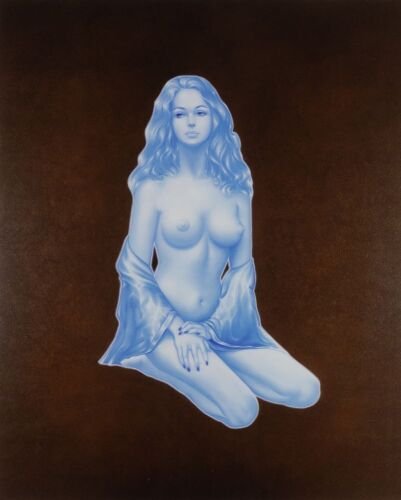
Lot 31. Liz Maw, Aura, 2002, giclée print on paper, 670 x 545mm. EST. $3,000—$4,000
Price Realised (Incl. BP): $4,481.25
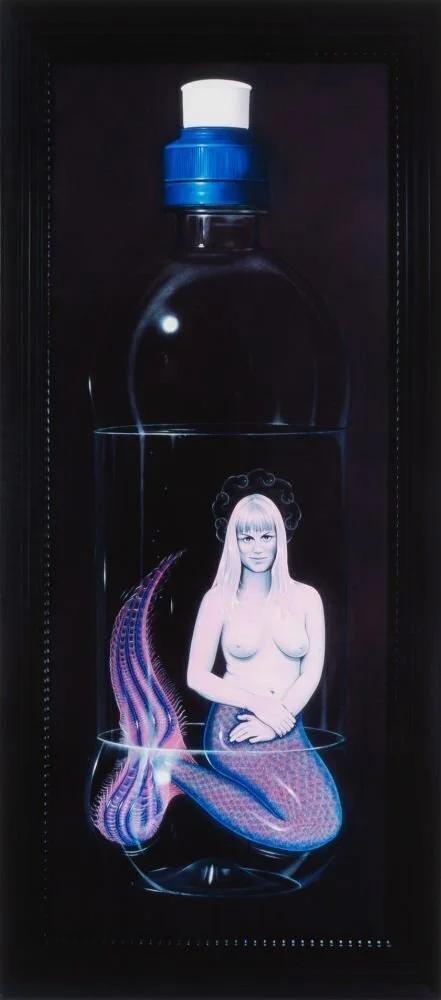
Lot 31. Liz Maw, Naiad, 2015, print on paper, 780 × 350mm.
EST. $3,000—$4,000
MS: Looking back at the work over time, how do you see your practice now?
LM: I'm a much better painter now. I just am. It's years and years of working.
But what pleases me is that the works still hold up. Even when I look and think, "that hand's not great," the painting still works.
Queen of Dreams (2025) was brutal. Two metres by two metres, nothing beats seeing it in the flesh. The last couple I've done, the one with the emergency blanket (The Untitled II, 2024) and Queen of Dreams, are probably the best works I've done.
MS: You've spoken about not wanting to fix meaning in the work. Tell me more about that?
LM: I don't mind being asked about the content, but I don't want to over-explain it. I want the same respect as any male painter. I've worked just as hard, if not harder, and I think I'm just as good.
Peter McLeavey always said to me, "You know, Liz, sometimes even the artists themselves don't know what the work is about."
And often things have been picked up. Like those kneeling nudes I did of Aura (2002) and Naiad (2015), I hadn't thought of them that way, but he reckoned they were a copy of a copy, like a pulp painting, stemming from Pania of the Reef in Napier, which I'd always loved. He called me up when it got stolen and asked if I was sitting down, I was devastated. But they found it again.
So there are things in the work that you don't fully know yourself. Your interpretation is as good as the next person's.
MS: As these works come to market, how do you want them to be positioned, and how does that sit alongside your own relationship to recognition?
LM: You've got to contextualise me. Connect me with other artists, it doesn't have to be women, just artists.
I've never really been in fashion. Being a woman, a painter, figurative, and using colour, it's almost like a quadruple disadvantage.
When I was younger, I really wanted recognition. Now I don't give a flying toss, apart from whether the painting works. That's all I care about. I am the measure.
There's that Pushkin quote: "Discriminating artist, does this please you?" That's it.
“You are a king. Live alone. Take a free road. And follow where your free mind leads you, Bring to perfection the fruits of well-loved thoughts. Ask no reward for noble deeds accomplished. Rewards are within you. Your supreme judge is yourself. None will ever judge your work more sternly. Discriminating artist, does it please you?”
—Alexander Pushkin
Webb's Art department curates and presents significant sales of historical and contemporary New Zealand and international art throughout the year, including single-owner collections, and our flagship Works of Art auctions. Our specialists work closely with private collectors, institutions and estates to research, catalogue and present works with the care and context they deserve, and we welcome enquiries about consigning artworks or entire collections for future sales.
Single Owner Live Auction | 28.07.26
Zoomorphic Lounge: A Private Collection of Modern and Contemporary Art
Nationwide Tour
Wellington
These events have finished
Launch | Wed 15 July
Viewing | 15—18 July
23 Marion Street, Te Aro
Christchurch
These events have finished
Launch | Thurs 9 July
Viewing | 7—9 July
249 Moorhouse Ave, Sydenham
Auckland
These events have finished
Launch | Tues 21 July
Viewing | 21—28 July
Live Auction | Tues 28 July, 6.30pm
33a Normanby Road, Mount Eden
View all articles & videos here